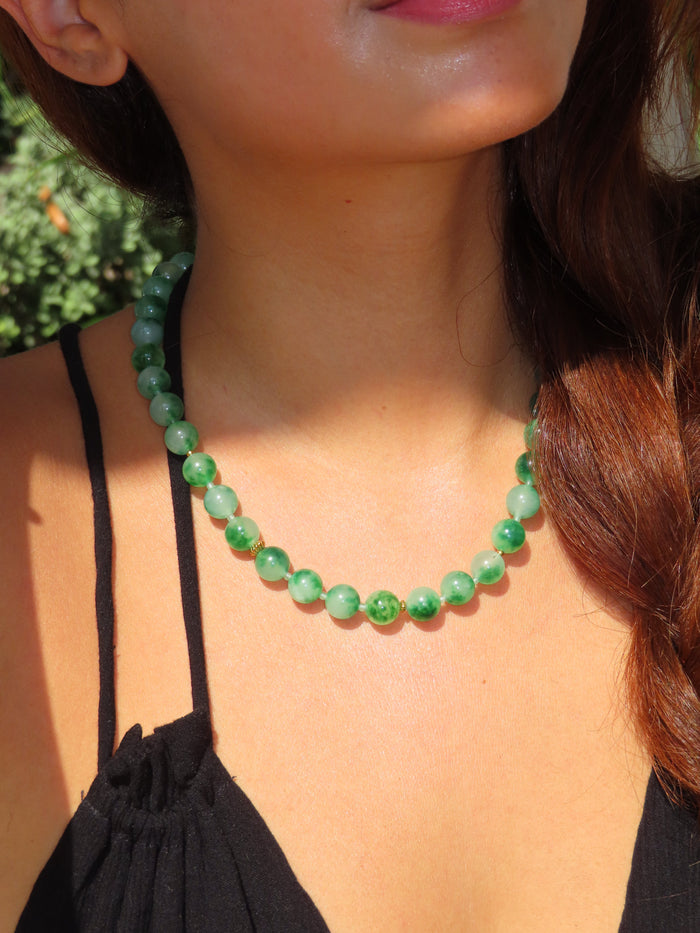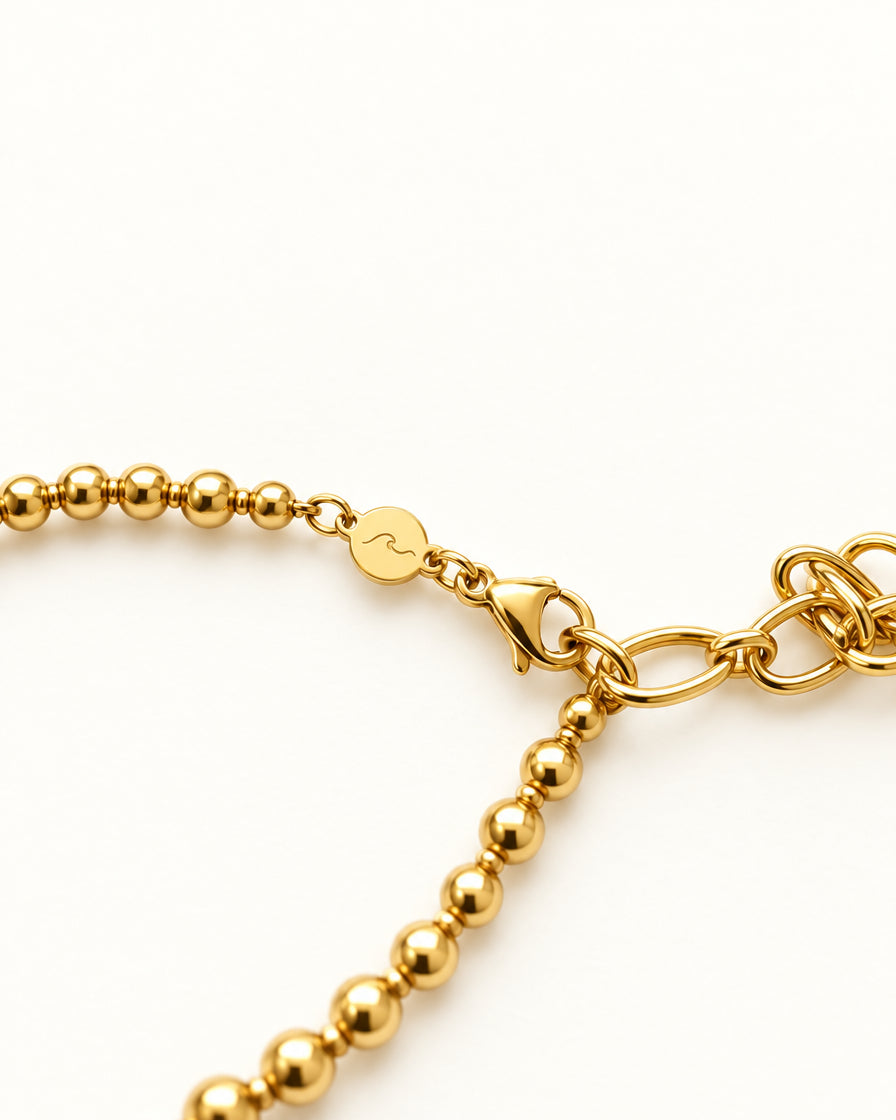
Walk through any jewellery site and you will meet the same three phrases: gold plated, gold vermeil, gold filled. They sound like grades of the same thing, cheapest to best. They are not. They describe three different constructions, and the differences matter more than the names suggest.
We make waterproof jewellery with 18k gold bonded to a stainless steel core. That means one of these categories is ours, and two of them are not. We will tell you where we sit and where we would send you instead.
Gold plated
Gold plated means a layer of gold applied over a base metal. That is the whole definition. There is no required base metal and, in practice, no meaningful floor on how little gold you can use and still use the words.
Standard costume plating runs somewhere around half a micron to one micron of gold. A micron is a thousandth of a millimetre. At that thickness the gold is a finish, not a material: it survives a handbag and a few careful outings, and it comes off at the points that rub, which is why plated rings go first and plated studs last longest.
What sits underneath matters more than most people realise. If the base is brass or copper, two things happen as the plating thins. The metal underneath oxidises, which is the green mark on your skin. And for anyone who reacts to nickel, the base becomes a problem the moment it is exposed.
Gold vermeil
Vermeil is the one with the strictest rules, and they are not the rules you would guess. Under the FTC jewellery guides, a piece can only be called vermeil if the base is sterling silver, at least 925 fineness, and the gold is at least 10 karat and at least 2.5 microns thick.
Read that again, because the important part is the base. Vermeil's legal guarantee is about what is underneath, not how much gold is on top. Sterling silver is a precious metal, it does not turn skin green, and it is why vermeil pieces feel like they have substance.
Two and a half microns is roughly two to five times a standard plating. It is real, and it is still a surface. Vermeil wears through eventually, and when it does you are left with a silver piece rather than a brass one, which is a considerably better place to end up.
Shop the pieces in this guide
Gold filled
Gold filled is the quiet winner on longevity and almost nobody markets it properly.
Instead of depositing gold electrically, a sheet of gold is mechanically bonded to a core, usually brass, under heat and pressure. To be sold as gold filled in the US, the gold must be at least 10 karat and must make up at least one twentieth of the item's total weight. That layer is typically fifty to a hundred times thicker than ordinary plating.
In practice, a well-made gold filled chain outlasts vermeil by years. The trade-off is the core: it is brass, not silver. If the gold is ever breached, you are back to a base metal.
Where we actually sit
Here is the part most brands skip.
By the FTC's definitions, what we make is gold plated. Not vermeil, because our base is stainless steel rather than sterling silver, and the rule is about the base metal. Not gold filled, because the gold is bonded by physical vapour deposition rather than mechanically clad. A piece can be plated with 24 karat gold to five microns over a non-silver base and it is still, legally, gold plated.
So we are in the same legal category as the costume jewellery that turns your finger green. The category is simply not very informative.
What makes the difference is the two things the category does not capture. The first is the base: ours is solid stainless steel, which contains no copper or brass, does not oxidise, and does not react with skin. Even in the worst case, where the gold wears at a contact point, what is underneath is steel. There is no green mark coming, because there is nothing there to make one.
The second is how the gold is attached. PVD bonds gold to the steel in a vacuum chamber rather than depositing it in a plating bath. The result is harder and more abrasion resistant than electroplating at the same thickness, which is why it is used on watch cases and surgical tools rather than only on jewellery. It is also why salt water, chlorine, sweat and sunscreen do not take it off.
When vermeil is the better buy
If you want a precious metal in your hand, buy vermeil. Sterling silver has intrinsic value, it can be resized and repaired by any jeweller, and a vermeil piece that wears through is still silver. Steel cannot be resized, and nobody is melting it down.
If you are buying something you intend to keep for decades and pass on, vermeil or gold filled is the honest answer, and we would rather say so than pretend otherwise.
If you want a fine chain that will take years of daily wear without ever meeting water, gold filled is hard to beat on durability for the money.
When ours is the better buy
If the piece is going to get wet, the calculation changes completely.
Sterling silver tarnishes. That is not a defect, it is what silver does in contact with sulphur in air and sweat, and under a 2.5 micron gold layer it will still happen at the edges and the join points over time. Chlorine is particularly hard on it. This is why vermeil brands tell you to take pieces off before swimming and showering, and why that advice is not them being overcautious.
We built around the opposite assumption. The reason we use steel is that we expect the jewellery to be worn in the sea, in the pool and in the shower, and never taken off. If you are the kind of person who takes jewellery off properly every night, vermeil will serve you well. If you are not, and most people are not, the steel core is doing the work.
The short version
Gold plated tells you almost nothing on its own: ask what the base metal is and how the gold was applied. Vermeil guarantees a sterling silver base and 2.5 microns of gold, which makes it the right choice for anything precious or dry. Gold filled gives you by far the thickest gold layer, over brass. And PVD on steel, which is what we make, is the one built for water.
Nobody needs all four. Buy for how you actually wear it.