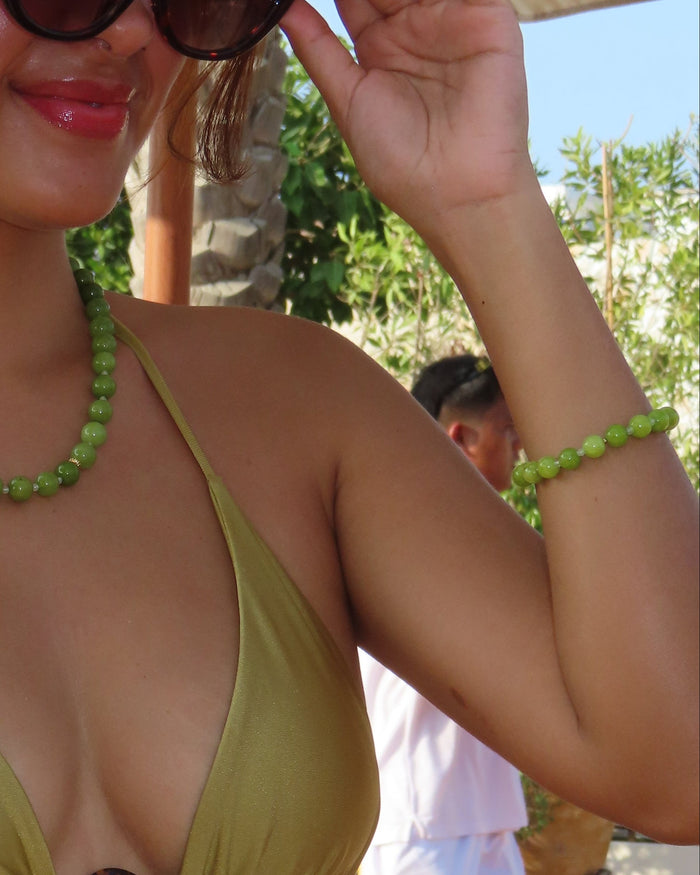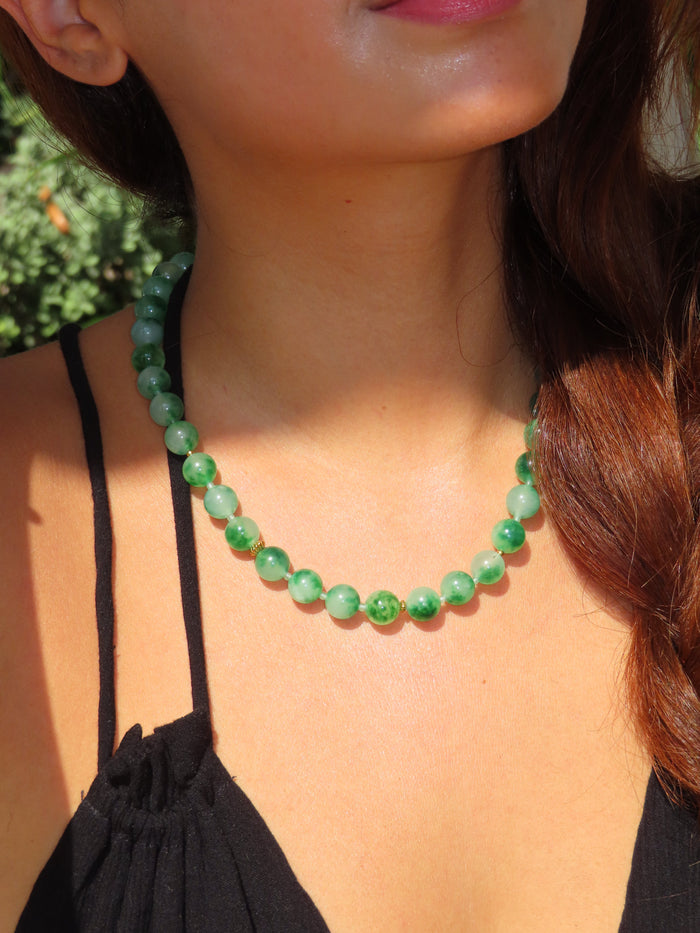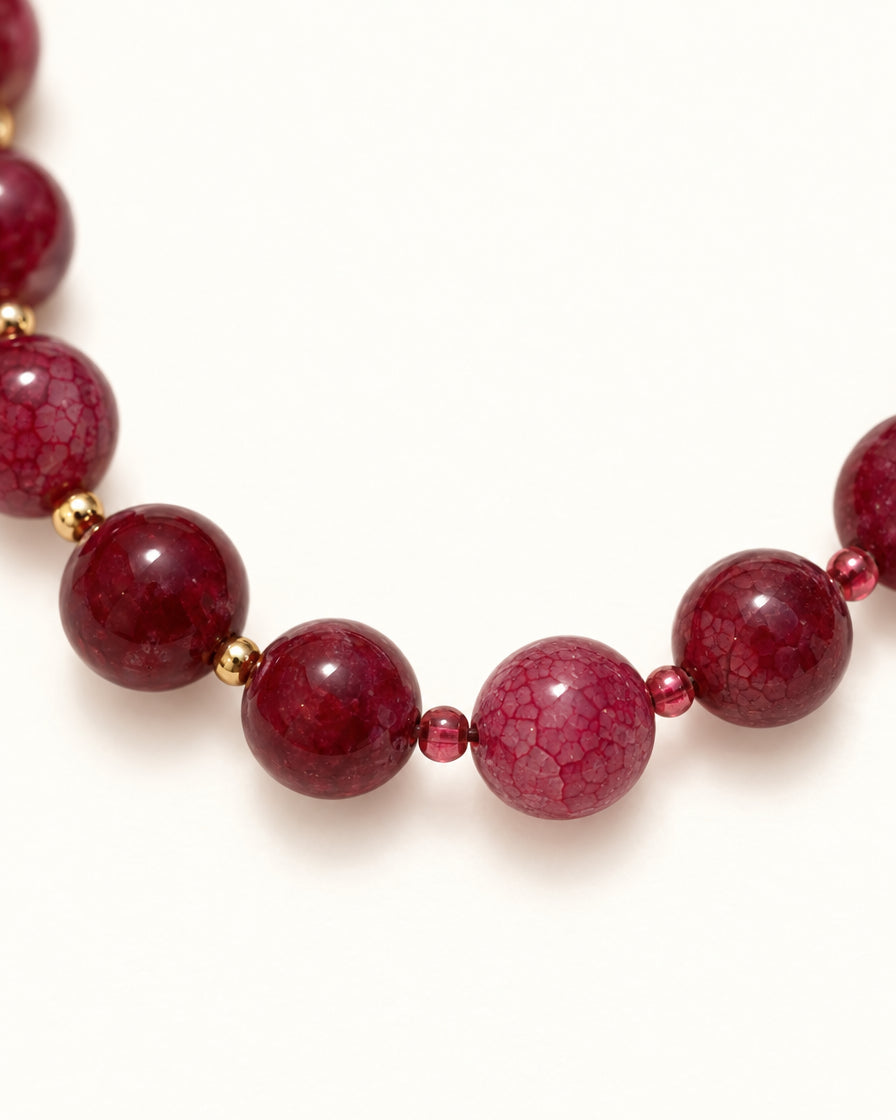
A beaded necklace in a product photo tells you almost nothing about what the beads are made of. Glass can be coloured, frosted, faceted and swirled to look like jade, agate, aventurine or opal, and on a screen the difference disappears.
That would not matter much if glass were always sold as glass, at glass prices. It is not. Some brands use glass beads and still charge more than others charge for natural stone. So it is worth knowing what you are looking at.
For the record: every bead in a Nusanoa piece is natural stone, cultured freshwater pearl or gold-plated steel. We do not use glass. Here is how to check that claim, ours or anyone else's.
What the difference actually is
Natural stone formed in the ground. Agate, tiger eye and aventurine are all forms of quartz, a crystalline mineral. Jade is its own mineral family. Each bead is cut from a larger piece of rock, so no two are quite the same.
Glass is made. It is mostly silica melted and cooled fast enough that it never forms crystals, then coloured and shaped in a mould or by hand. That is why it can be produced in perfectly even colour and in any shade a designer wants.
Neither is good or bad in itself. Fine glass beadwork, from Venetian to Czech, is a craft with centuries behind it. The problem is only when one is sold as the other, or priced as if it were.
Five ways to tell them apart
1. Look for perfect bubbles
This is the most reliable check you can do at home. Glass often traps tiny gas bubbles as it cools, and they are perfectly round. Natural stone can have inclusions, veils, specks and hairline flaws, but not perfectly round bubbles. A phone camera zoomed in, or a cheap 10x jeweller's loupe, is enough to see them.
2. Look for seams and swirls
Moulded glass beads sometimes carry a faint seam line where the two halves of the mould met, or a slightly stirred, swirled look inside. Stone has banding and grain that follow the rock, not a pattern that wraps neatly around the bead.
3. Check whether every bead is identical
A strand of natural jade or tiger eye varies from bead to bead: one a little darker, one with a stronger band, one with a fleck. A strand of glass is often uniform to the point of looking printed. Perfect consistency is not proof of glass, but it is a reason to look closer.
4. Feel the temperature
Stone conducts heat better than glass. Hold a bead against your lip or the inside of your wrist: natural stone feels cool and stays cool for a moment, while glass warms to your skin almost immediately. It takes a little practice, and it is easiest when you can compare the two side by side.
5. Hardness, which is how jewellers test it
On the Mohs scale, ordinary glass sits around 5 to 5.5. Quartz, which includes agate, tiger eye and aventurine, sits at about 7. That is why quartz will scratch glass and not the other way round. It is the test a jeweller or gemmologist uses, but we would not try it on jewellery you want to keep wearing.
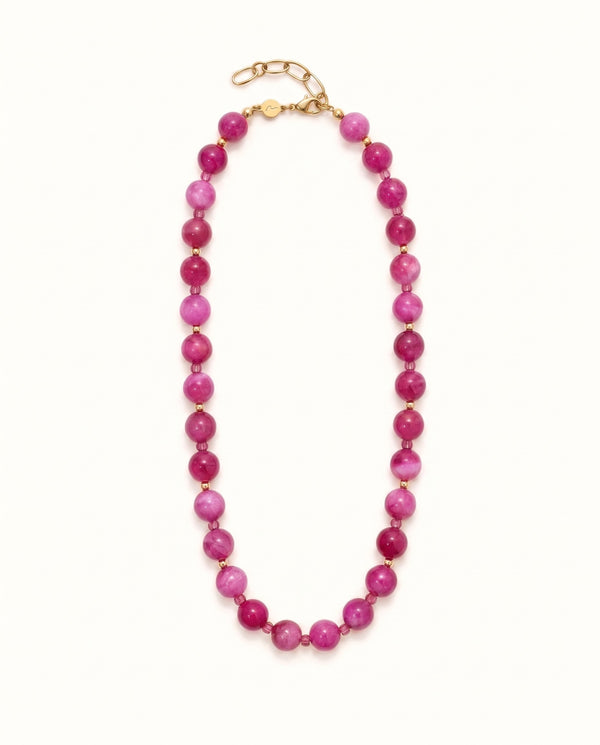
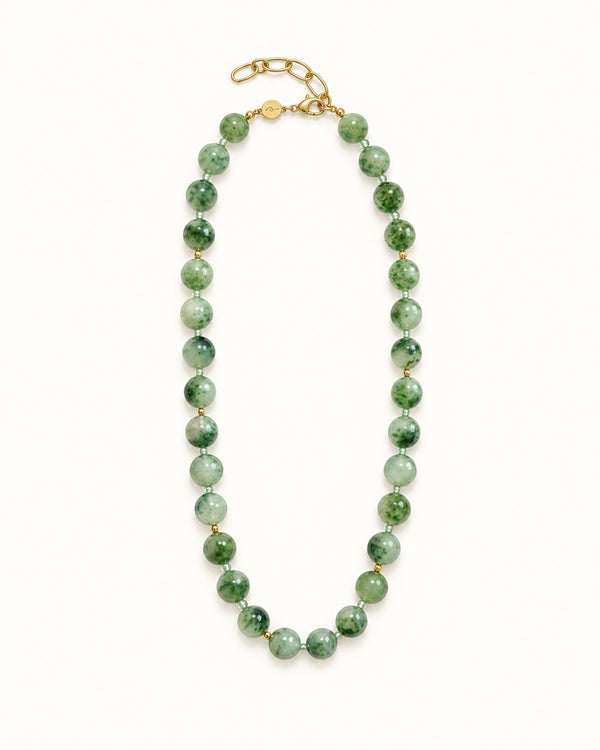
Shop the pieces in this guide
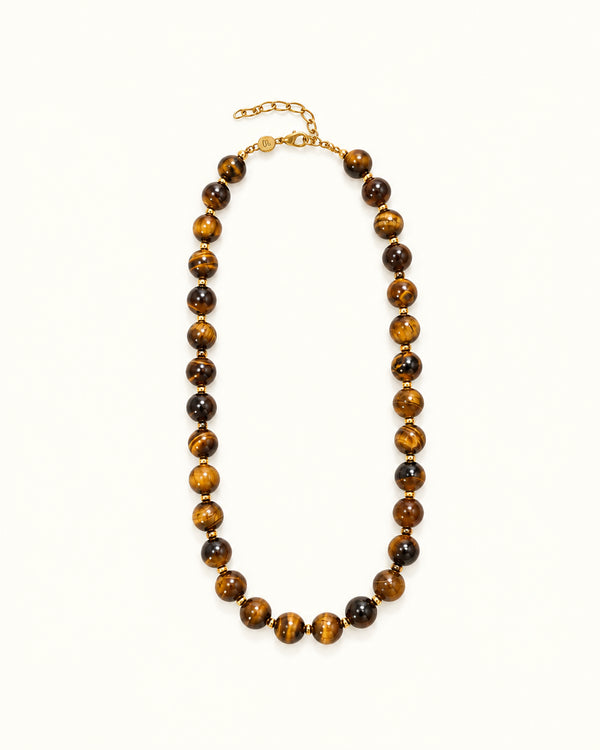
One test that does not really work: weight
You will often read that stone beads feel heavier than glass. For most quartz stones the difference is small, because glass and quartz have similar density. A scale in a kitchen will not tell you much. Jade is noticeably denser and does feel heavier in the hand, but for agate and aventurine, trust bubbles, seams and temperature over weight.
Trade names that are usually glass
Some names sound like stones and are not. When you see these, you are almost always looking at glass:
- Goldstone: glass with copper flakes that glitter. It is made to imitate the shimmer of aventurine, which is one of the stones we use. Real aventurine has a soft, uneven sparkle from tiny mineral flakes; goldstone glitters evenly throughout.
- Cherry quartz: a pink-red glass, not a variety of quartz.
- Opalite: a milky, blue-white glass sold as an opal or moonstone look-alike.
None of these are dishonest products when they are labelled as glass. They become a problem when the listing lets you assume otherwise.
A note on dyed stone
Dyed stone is not the same as glass. Agate in particular is very often dyed to deepen or change its colour, and a dyed agate is still agate: same hardness, same weight, same feel. If colour matters to you, it is a fair question to ask any brand, including us.
What to ask before you buy
- What exactly are the beads made of? "Stone-effect", "gemstone-look" and a stone name in quotation marks are all ways of not saying.
- Is the stone natural, and is it dyed or treated?
- What is underneath the gold? That question matters more for how long a piece lasts than the beads do, and we wrote about it in gold plated vs vermeil vs gold filled.
What is in ours
Every Nusanoa piece is natural jade, tiger eye, agate or aventurine, cultured freshwater pearl, or plain polished gold, all on 18k gold bonded to stainless steel. No glass anywhere in the range. Look closely at a strand and you will see it: every bead a slightly different shade, because every bead came from a different part of the rock.
The short version
- Glass beads are perfectly uniform; natural stone varies bead to bead.
- Quartz-family stones are harder than glass, so they scratch less easily.
- Names like goldstone, cherry quartz and opalite are glass.
- Ask the seller what the beads are, and expect a straight answer.